

- About Us
- Blog
- Areas We Serve
- Virtual IOP
- Our Programs
- Tour
- Mental Health Treatment
Neurofeedback Therapy in Los Angeles
To understand exactly what is neurofeedback, we must first understand how brainwaves work.
When brain cells communicate with each other, they produce synchronized electrical impulses—which appear as brainwaves. So for any behavior, emotion, or thought that crosses your mind, there is a trail of brainwaves.
Neurofeedback therapy uses special sensors place on the scalp to measure these brainwaves, which have different frequency bands (measured in cycles/seconds or Hertz). Depending on the specific activity levels, the waves alternate between:
- Delta brainwaves (1 to 4 Hz): These often occur during deep stages of sleep, which includes the restorative stage where the body repairs itself and we’re not aware of our body
- Theta brainwaves (4 to 8 Hz): Remember those times when your mind just wanders off and your senses seem to be withdrawn from the external world? Well, you were likely in a theta brainwave state
- Alpha brainwaves (8 to 12 Hz): Alpha waves are associated with a mindful state of calm and relaxation, such as when a person is meditating or sitting down to rest after completing a task
- Sensori-motor Rhythm (SMR) brainwaves (12 to 15 Hz): This wave pattern is associated with an alert, attentive state like what you’re experiencing right now as you read this post
- Beta brainwaves (15 to 32 Hz): Beta waves are characteristic of a mind that is actively engaged or aroused, such as when you’re actively debating an issue
Think of your brainwaves as musical notes. Higher frequencies are like a high-pitched flute, while lower brainwave frequencies are like a deep drum beat. The different brain frequencies gel together to create a “symphony” that generate your brain activity.
During your typical day-to-day activities, such as class discussions or making a presentation at work, a normal brain should be using the Beta frequency. But when any of the brainwaves are imbalanced, this corresponds to problems with our mental health.
For example, too much activity in certain areas of the brain may manifest as impulsive behavior (as seen in patients with an obsessive-compulsive disorder).
The same applies to people with attentional issues, anxiety, chronic pain, depression, addiction, insomnia, PTSD, stress, or traumatic brain injury – all caused by an imbalance in brainwave activity.
Neurofeedback measures and monitors these frequencies to identify the specific activity that is creating undesirable feelings or abnormal brain function. After accurately mapping out your activity level, we create a plan to help you achieve a healthier mental state. This brings us to the definition of neurofeedback.
Neuro feedback therapy basically works in two steps:
- Assessing brainwave activity
- Training the brain to self-regulate itself
As such, it’s not considered a cure, but instead, it’s a way to regulate manage the brain to help it function in a healthier manner.
Neurotherapy uses EEG sensors to monitor brain activity, and a computer to relay back the feedback. Depending on the circumstances, a trained neurofeedback practitioner may use different stimuli to receive this feedback – including watching a video, listening to music, or playing a game.
This is based on the fact that our brains are malleable or “neuroplastic,” meaning it’s possible to change how they function.
According to a study published in the Journal of Neurochemistry, our brains have the amazing ability to continually adapt to changes in the environment. With this in mind, neurotherapy attempts to stimulate the brain to act more desirably by using “operant conditioning.”
A good example of operant conditioning is when a dog receives a snack every time he rolls over on command. Over time, the canine will learn that rolling leads to snacks – and the chances of responding to such a command in the future will be higher.
Similarly, neurofeedback therapy uses brainwave data and a ‘reward system’ to train the brain.
When you generate desirable brain activity, you’re rewarded with a positive outcome such as gaining points in the video game. But when your brainwaves fire at an undesired frequency, you receive negative feedback such as pausing the music.
In such a case, the brain learns that the particular brain activity is out of balance and it should find a way to get a positive response.
Repeated exposure (approximately 20 to 40 sessions) promotes long-lasting changes in brain activity. Even outside the neuro feedback therapy sessions, your brain will be “conditioned” to operate in an optimal range.
This is just like physical training, where the more you exercise, the closer you get to reaching a more efficient and optimal state.
Mental health and neurological disorders are typically characterized by certain patterns of brain activity.
The goal of neurotherapy is to improve the brain’s ability to smoothly shift between states of arousal and relaxation. It locates specific pathways that are either over-activated, under-activated, or dysregulated.
By modulating the brain’s functions such as Affect regulation, Emotional regulation, and Attention regulation, neurotherapy can help with several neurological issues.
It has shown to be useful for children or adults diagnosed with conditions such as PTSD, anxiety disorders, depression, and addiction, among others.
When someone is addicted to something, they tend to depend on it and even give it the same level of significance as food. They think it’s a necessity and any attempt to take away the addictive substance is often met with resistance.
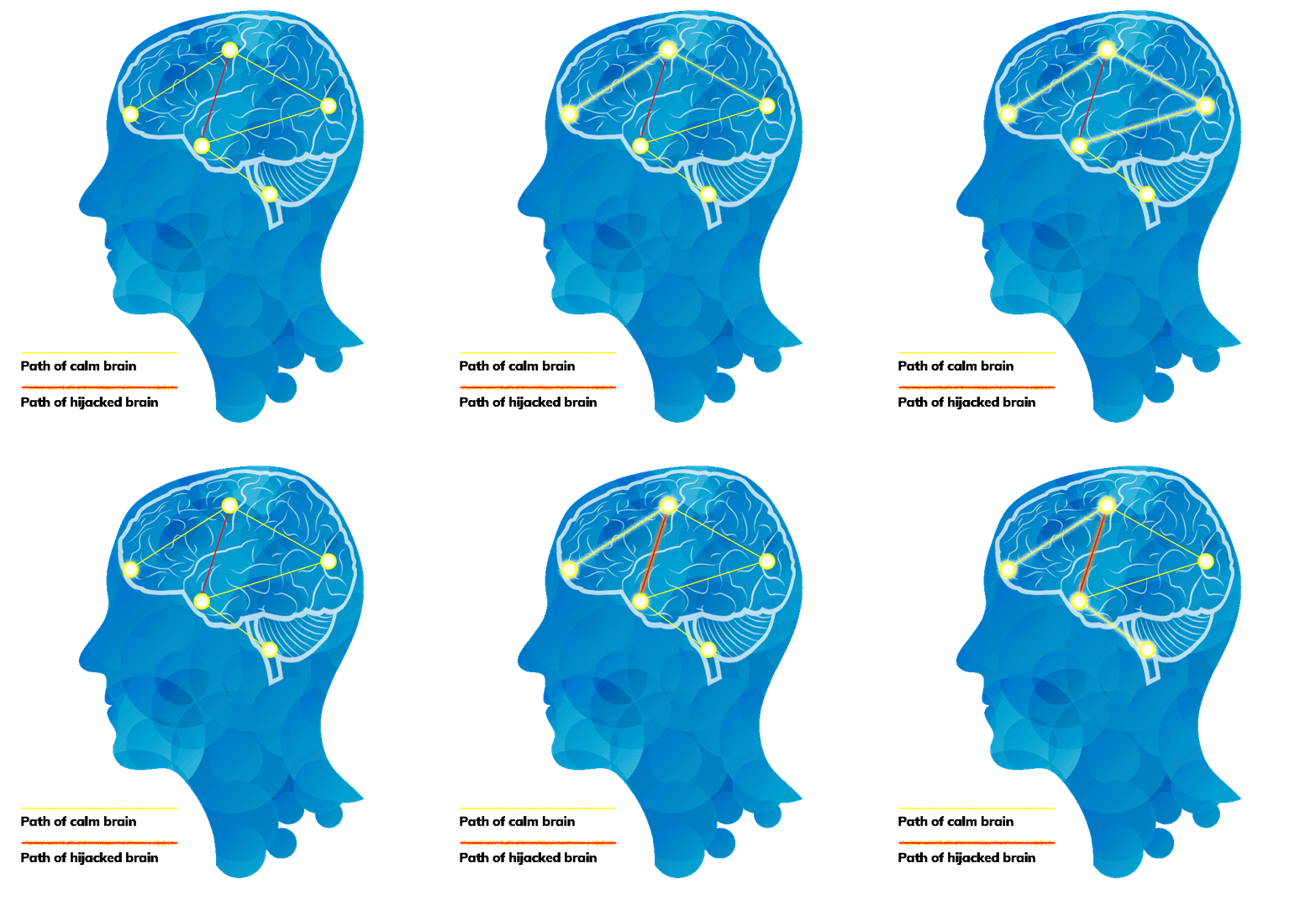
According to some researchers, addiction leads to the disruption of brain circuits involved in reward and control. Over time, other areas of the brain such as those involved in anxiety are ‘recruited’—creating a hijacked brain.
The reward system becomes over-stimulated and patients lose control. Luckily, this is not set in stone. As highlighted earlier, the brain is malleable and open to suggestions.
Neurotherapy pinpoints the misfiring brainwaves associated with a hijacked brain, and conditions or trains the brain to self-regulate. It helps identify comorbidities, which are underlying issues that may hinder a patient’s journey to recovery. This reduces resistance to addiction treatment—improving aftercare compliance and long-term abstinence.
A handful of the leading drug and alcohol addiction recovery centers such as Iris Healing® offer holistic services – including leveraging neurotherapy and neurofeedback – to support and improve the outcome when used in conjunction with other healing modalities.
According to a landmark study published in The American Journal of Drug and Alcohol Abuse, a team of researchers from UCLA found that the number of patients who prematurely leave a treatment program was reduced by 60% when they received neurofeedback therapy.
Additionally, 77% of the neuro feedback patients abstained for at least 12 months, compared to 44% of those who did not receive neurotherapy.
They concluded that, “This protocol enhanced treatment retention, and improved variables of attention and abstinence rates one year following treatment.”
According to the Diagnostic and Statistical Manual of Mental Disorders (DSM-5), post-traumatic stress disorder (PTSD) is a condition that is associated with “exposure to actual or threatened death, serious injury or sexual violation.”
Children, adolescents, or adults diagnosed with PTSD often re-live the trauma in the form of flashbacks that traumatize them. This causes impairment or distress in an individual’s capacity to function and interact with others.
EEG Biofeedback Therapy– specifically the alpha-theta protocol – helps bring a patient to a state of deep calm where they can access the dislodged memories and release the false beliefs or trauma.
Aside from giving the patient a healthier perspective of life, neurotherapy also makes the brain more receptive to other therapies.
In a study appearing in the Journal of Medical Psychotherapy, the researchers monitored the outcome of alpha-theta brainwave neurofeedback treatment on Vietnam veterans diagnosed with combat-related PTSD.
According to their findings, the level of beta-endorphins (blood stress hormone) decreased throughout the therapy. In the end, PTSD patients who underwent neurotherapy had similar profiles to their counterparts who had never been diagnosed with the disorder.
In a 10-year follow up, only 3 neurofeedback patients had relapsed, compared to 14 among the group that underwent traditional treatment. This shows that neuro feedback therapy is efficacious in treating PTSD and preventing relapse.
According to the World Health Organization (WHO), depression affects over 264 million people around the world, and it’s the leading cause of disability.
Similarly, the Anxiety and Depression Association of America (ADAA) notes that anxiety disorders are the most common mental disorders in the world. With such high prevalence rates, it important to find effective ways to curb the problems.
Similarly, a pilot study in the PloS One peer-reviewed journal concluded that “neurofeedback aimed at a reduction of frontal asymmetry of alpha-activity may be effective as a treatment for depression.”
For anxiety disorders, the team at Iris Healing® can either use alpha-theta, SMR, or beta neurotherapy protocols to address the problem at its source.
For example, if you have reactionary anxiety as seen in people with a phobia, we will use alpha-theta biofeedback.
If you have generalized anxiety – stemming from an over-activated brain – SMR protocols can help slow down the brain. This makes everyday activities (that would have otherwise been distressing) easier to manage.
The effectiveness of neurofeedback treatment for anxiety and depression is supported by a study published in the Journal of Adult Development.
The scientific evidence on the applicability of neurofeedback is also promising for several other mental health problems including:
According to an article published in the Journal of the American Board of Sport Psychology, neurofeedback can also help an athlete achieve peak performance by reducing mental chatter, lowering anxiety, and improving concentration.
Neurofeedback therapy at Iris Healing® is often preceded by a private consultation and assessment with one of our trained experts.
We will begin with a preliminary discussion to understand your needs and what our neurofeedback services can offer to help. This includes a walk-through of our neurotherapy process, the measures we will employ to meet the full extent of your expectations, and an EEG appointment.
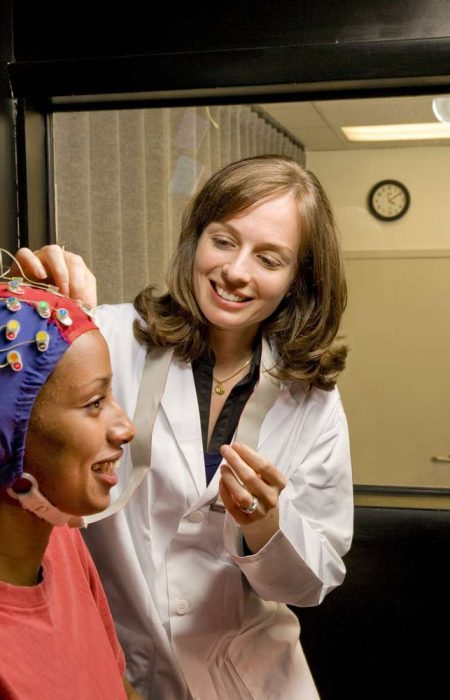
In your first appointment, you’ll be asked a set of questions to help develop a fine-tuned therapy protocol that’s tailored to your unique characteristics. The technician will then place sensors on your scalp and ear (don’t worry, they’re non-invasive and won’t hurt).
The session typically takes around 30 minutes, and during that time the provider may change the placement of the sensors. This helps us visualize the baseline of your brain activity and formulate a treatment schedule.
Depending on the therapy protocol, you may receive feedback with your eyes closed or open. When closed, the focus is on auditory feedback. The alpha brain wave frequency typically rises as your mind drifts into a mindful, meditative, and relaxing state.
When your eyes are open, you will watch fractal morphing along with some graphs while focusing on both visual and auditory cues.
To effectively “train the brain,” it’s important to keep it in an active state of learning and growth. For this reason, we will schedule sessions based on the most effective and practical frequency (at least 2 sessions per week).
During a training session, we will evaluate your progress by tracking the presentation of your symptoms and your overall experience. Each session is designed to build on the pervious one in a progressive manner.
Utilizing the Iris Healing® Neurofeedback Program in Los Angeles gives you access to the best medical practices and neurofeedback protocol to optimize the outcome of your recovery for mental health issues and addiction.
Our focus is on holistic healing and recovery. To achieve this, we go beyond the symptoms and instead tackle your problem from its roots. Our program combines different healing modalities to effectively treat your mental health issues and prevent relapses.
Iris Healing® uses the BrainPaint Neurofeedback System, which includes practices and protocols that are customized just for you.
By using a systematic approach and measurable results, we can ensure more consistent outcomes than other providers.
It’s also worth noting that the BrainPaint Neurofeedback System automates the exact alpha-theta implementation that was used to help addiction and PTSD patients in the landmark UCLA study (the largest randomized control study in the field).
Additionally, the software is designed in such a way that you can seamlessly move to or from another treatment center and retain the progress of all your previous protocols.
Iris Healing® strives to be diligent and prompt in updating the information available on our website. Please note, however, that our treatment modalities and protocols are subject to change at any time. For the most up-to-date details regarding our treatment offerings or other protocols, please contact us: (844)663-4747
